The Importance of Narrative-Driven Instruction: Resources for Secondary Learners
By Dr. Alejandra A. Fernández Morgado
Adolescents are not arriving at school as blank slates. They are already interpreting the world through their identities, languages, relationships, communities, histories, interests, and experiences. Narrative-driven instruction treats that knowledge as intellectually valuable.
Narrative is more than storytelling. It can become a pathway for inquiry, disciplinary learning, critical thinking, identity development, and academic agency.
The Importance of Narrative
Narrative-driven instruction can help secondary students:
-
Connect academic concepts to real people, communities, and experiences
-
Examine whose perspectives become accepted as knowledge
-
Develop voice, argumentation, analysis, and disciplinary thinking
-
Explore identity without separating learning from lived experience
-
Use multilingualism and cultural knowledge as intellectual resources
-
Demonstrate strengths that conventional participation and assessment may miss
-
Examine systems, barriers, resistance, belonging, and possibility
For multilingual learners, students with disabilities, and students with advanced potential—including twice- and thrice-exceptional learners—narrative can reveal complexity that labels and test scores cannot.
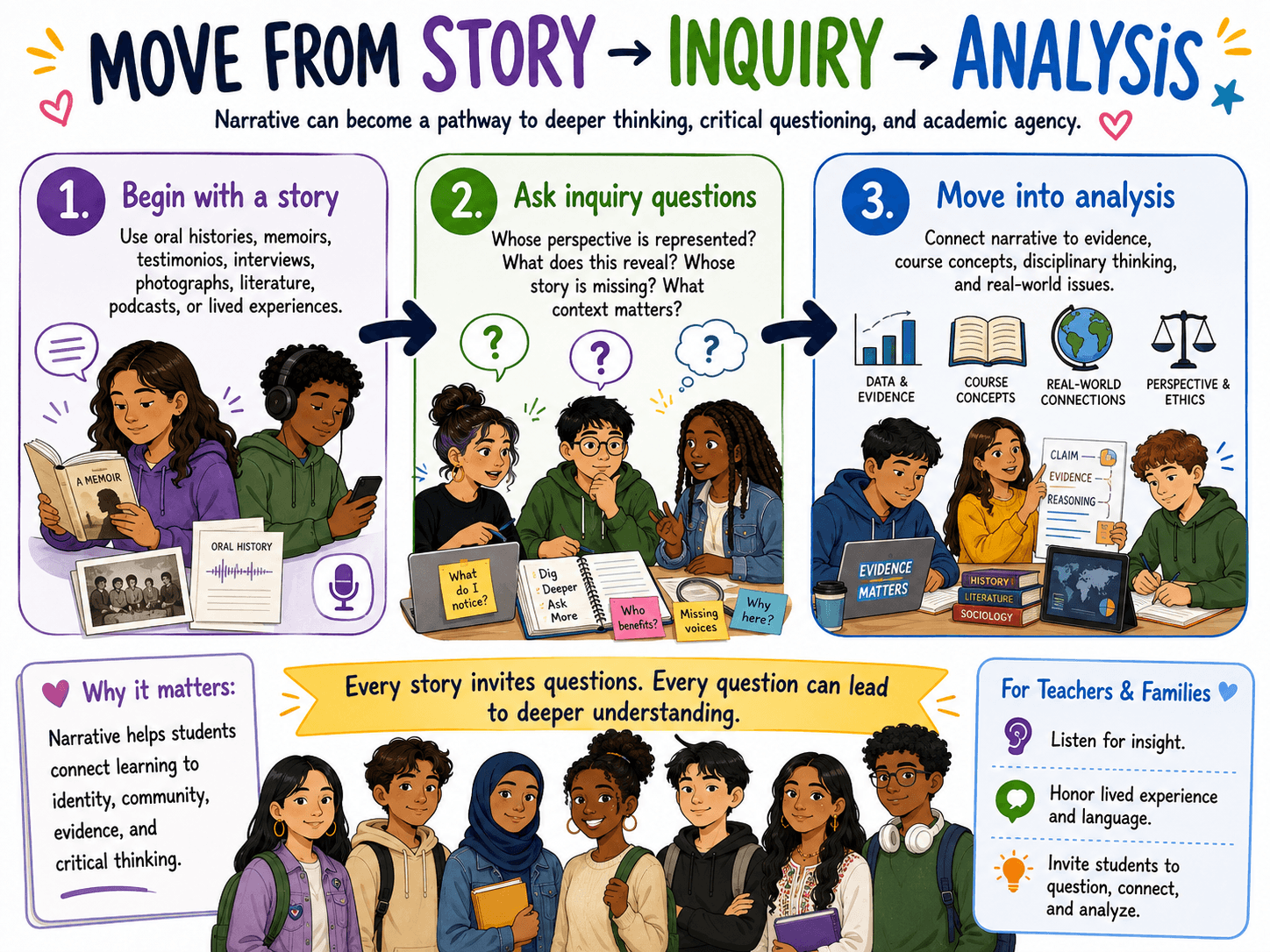
1. Begin with a narrative.
Use oral histories, memoirs, testimonies, interviews, photographs, podcasts, literature, primary sources, community events, or students’ own experiences.
2. Ask what the narrative reveals.
-
Whose perspective is represented?
-
What knowledge does this person hold?
-
What social, historical, cultural, or political context matters?
-
Whose perspective is missing?
-
Who has the power to define what counts as knowledge?
3. Connect narrative to disciplinary learning.
-
ELA: voice, perspective, rhetoric, counternarrative
-
History/Social Studies: oral history, migration, policy, community memory
-
Science: environmental experience, ethics, community knowledge, scientific decision-making
-
Mathematics: data stories, inequities, patterns, modeling real-world experiences
-
Arts: identity, representation, visual narrative, performance
-
Career/Technical Education: family expertise, community practices, pathways and problem-solving
4. Expand how students can demonstrate understanding.
Consider:
-
Podcasts
-
Digital stories
-
Testimonios
-
Photo essays
-
Interviews
-
Multimedia presentations
-
Community maps
-
Spoken-word pieces
-
Analytical essays
-
Bilingual or multilingual products
Simple Classroom Ideas
Whose Story Is Missing?
After studying a historical event, scientific issue, literary work, or dataset, students identify perspectives absent from the dominant account.
Community Knowledge as Evidence
Students interview someone with lived or professional knowledge connected to a course topic and compare that knowledge with traditional academic sources.
Counterstory Project
Students investigate a stereotype, assumption, or dominant narrative and construct an evidence-based counternarrative.
Narrative & Data
Pair statistics with individual or community stories. Ask students what each source of evidence reveals and what each cannot reveal alone.
For Families
Adolescents may not always tell their stories in traditional school language. Families can help educators recognize:
-
Interests and areas of expertise
-
Languages and cultural knowledge
-
Responsibilities students carry outside school
-
Experiences that have shaped their perspectives
-
Community connections
-
Aspirations and possible future pathways
-
Strengths that may not appear in grades or standardized measures
Academic rigor does not require removing identity from learning. Meaningful rigor asks students to connect knowledge, question assumptions, examine evidence, and contribute their own thinking.
A Question To Carry With You
Whose knowledge becomes visible when students are invited not only to learn the curriculum, but to enter into conversation with it?