The Importance of Narrative-Driven Instruction: Resources for Elementary Learners
By Dr. Alejandra A. Fernández Morgado
Every child enters the classroom with stories, knowledge, language, relationships, interests, and ways of understanding the world. Narrative-driven instruction begins there.
Rather than asking students to leave parts of themselves at the classroom door, narrative-driven instruction uses students’ lived experiences as resources for learning. Stories can help educators recognize what students know, make meaningful connections across content areas, and create more ways for children to demonstrate strengths that may not immediately appear on traditional assessments.
The Importance of Narrative
Narrative-driven instruction can help children:
-
See themselves in the curriculum
-
Connect new learning to family, culture, language, and community
-
Develop vocabulary, comprehension, communication, and critical thinking
-
Share knowledge through multiple languages and modes of expression
-
Recognize that their experiences and perspectives are valuable
-
Demonstrate strengths, creativity, curiosity, and advanced potential that might otherwise be overlooked
For multilingual learners, students with disabilities, and students whose strengths do not always fit traditional measures, stories can provide another pathway to being seen.
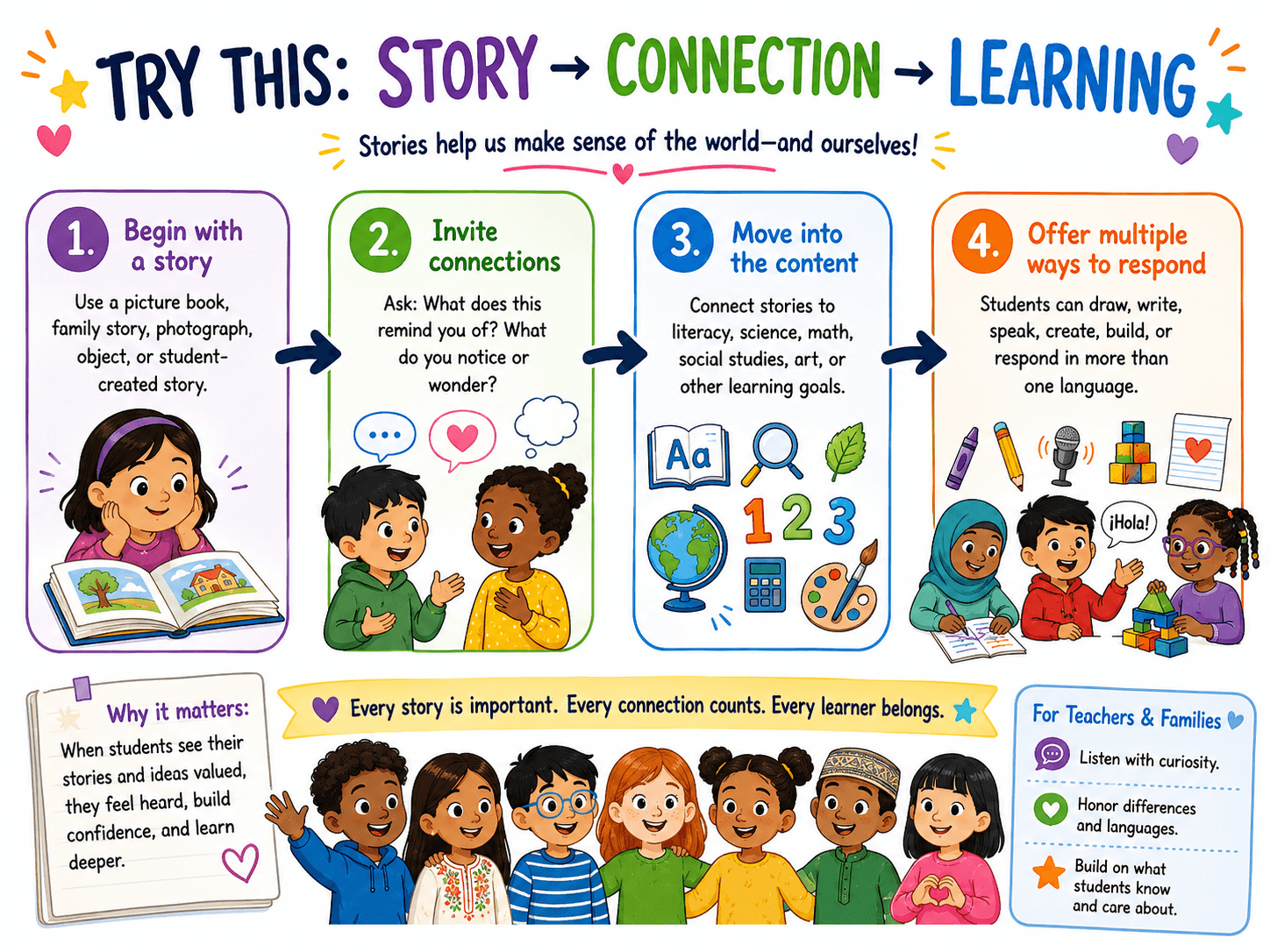
1. Begin with a story.
Use a picture book, family story, photograph, object, classroom experience, oral history, or student-created narrative.
2. Invite connections.
Ask:
-
What does this remind you of?
-
Have you experienced something similar?
-
How might your family or community understand this?
-
What do you notice or wonder?
3. Move into the content.
Connect those narratives to literacy, science, mathematics, social studies, art, or other learning goals.
4. Offer multiple ways to respond.
Students might:
-
Draw
-
Tell or record a story
-
Write
-
Create a comic
-
Build or design something
-
Respond bilingually or multilingually
-
Use photographs, objects, movement, or art
Simple Classroom Ideas
Identity Maps
Students create a visual map of people, places, languages, traditions, interests, and experiences that matter to them.
Family & Community Knowledge
Invite children to investigate something their family or community knows how to do—cooking, gardening, repairing, storytelling, music, caregiving, building, navigating, creating, or problem-solving.
Story Before Strategy
Before teaching a new concept, invite students to tell where they have encountered something similar in everyday life.
Multiple Versions of a Story
Read stories representing different perspectives and ask: Whose story are we hearing? Whose story might be missing?
For Families
You can support narrative-driven learning by sharing:
-
Family stories and memories
-
Home languages and expressions
-
Photographs and meaningful objects
-
Cultural traditions and community knowledge
-
Your child’s interests, curiosities, and strengths
-
Ways your child learns or communicates best
Children should not have to choose between academic success and who they are. Their stories can become part of how learning happens.
A Question To Carry With You
What might we discover about a child if we begin by asking, “Tell me your story,” instead of only asking, “What can you do?”